Taking a Rental Car Across Balkan Borders
Montenegro shares land borders with five countries: Croatia, Bosnia and Herzegovina, Albania, Kosovo, and Serbia. Driving a rental car into any of them is permitted, tick the country at booking and the paperwork is ready when you collect the keys.
The Green Card Explained
A Green Card (Carte Internationale d'Assurance Automobile) is a standardised document proving your vehicle carries valid third-party insurance in the country you are entering. Border guards ask for it at every Balkan checkpoint. Without one, you will be turned around.
- Typical cost: around 15 euros for a 15-day period
- Issued by: the rental company, at no hassle to you, just confirm the countries you plan to visit when booking
- Standard coverage: Croatia, Bosnia, Albania, Serbia. Kosovo may need to be added separately
Before setting off, open the glovebox and verify the Green Card lists every country on your route. A card valid for Croatia alone will not get you into Bosnia. Five minutes of checking saves hours of frustration at the checkpoint.
Your Border Document Checklist
- Passport or EU national ID card (must be original, not a photocopy)
- Driving licence, an international driving permit is recommended alongside non-Latin-script licences
- Original rental contract with company stamp (printed, not a screenshot on your phone)
- Green Card insurance certificate listing all destination countries
- Vehicle registration certificate (kept in the car by the rental company)
Country-by-Country Crossing Details
Into Croatia: Debeli Brijeg
The E65 coastal crossing between Herceg Novi and Dubrovnik is by far the most popular, and therefore the most congested. In July and August, two passport checks (Montenegrin exit, Croatian entry) combine with heavy tourist traffic to produce queues of one to two hours. The crossing itself is a simple road checkpoint with booths on both sides.
Timing matters enormously. Cross before 08:00 or after 20:00 and the wait drops to minutes. Weekday mornings are dramatically quieter than Saturday or Sunday. If you must cross mid-afternoon in August, bring water and patience.
Heading north from Kotor, the Kamenari, Lepetane car ferry crosses the narrowest point of the bay in about five minutes, saving a 45-minute drive around the inner shore via Tivat. Ferries run continuously; the fare is a few euros. Hiring from Dubrovnik Airport is the most popular cross-border option.
Into Albania: Sukobin or Hani i Hotit
The coastal crossing at Sukobin/Muriqan, south of Ulcinj, is the more straightforward route, well-signed, with generally short queues. The inland alternative at Hani i Hotit, near the southern shore of Lake Skadar, is scenic but quieter and less familiar to foreign tourists.
Pushing on to Tirana from either crossing takes roughly three and a half hours. Hani i Hotit via Podgorica is the faster route: motorway to the border, then the SH1 through Shkodra, Lezha and Durrës straight into the capital. The coastal Sukobin option adds 40-50 minutes but gives you the Albanian Riviera past Velipojë. Tirana's ring-road signage is sparse for first-timers, so route the drive into Google Maps before you set off and expect the last twenty minutes of city driving to be slower than anywhere in Montenegro.
Albanian road infrastructure is improving rapidly but remains unpredictable outside main highways. Speed limits drop on rural roads and surface quality can change without warning. Drive defensively, particularly at night.
For overland routes south, Podgorica Airport is the most convenient collection point, with direct road links to the Albanian border.
Ready to Explore the Bay of Kotor?
Free cancellation availableNo card neededLive rates
Into Bosnia: Šćepan Polje or Vilusi
Heading north from the coast, the Šćepan Polje crossing near Foča accesses the Tara River gorge and Sutjeska National Park. From Nikšić, the Vilusi crossing provides a route toward Trebinje and eventually Mostar. Both are lightly used and rarely involve waiting.
Into Serbia: Dobrakovo
The Dobrakovo checkpoint on the E65, north of Bijelo Polje, connects to the Serbian motorway network. From there, Belgrade is roughly four hours of straightforward motorway driving. Tolls are charged at motorway entry and exit booths, take a ticket when you join and pay based on distance when you leave.
Into Kosovo: Kula
The Kula crossing near Rožaje leads to Peja/Peć in western Kosovo. Confirm with your rental company that Kosovo is explicitly listed on your Green Card, several insurers exclude it by default, and border guards will check.
Practical Queue Advice
- Arrange documents in a single envelope on the dashboard before joining the queue. Fumbling at the window wastes time
- Switch off the engine while stationary, guards notice and it puts them at ease
- Avoid the Debeli Brijeg crossing on Saturday and Sunday afternoons between June and September
- Inland crossings (Bosnia, Serbia, Kosovo) are almost always faster than the coastal Croatian one
- Carry euros in cash. Croatian motorway tolls accept cards, but Bosnian and Albanian fuel stations sometimes do not
- Check your mobile roaming plan before crossing. Data charges spike the moment your phone connects to a foreign network
Traffic Laws That Change at the Border
Regulations differ from one country to the next. The main surprises:
- Croatia: daytime running lights mandatory at all times. Motorway tolls are collected by cash or card at barrier stations
- Albania: lower speed limits on secondary roads than in Montenegro. Livestock on the carriageway is not uncommon outside towns
- Bosnia: winter tyres compulsory from November through April. A first-aid kit and warning triangle must be in the vehicle
- Serbia: absolute zero-tolerance alcohol limit. Motorways use toll booths, take a ticket on entry, pay on exit based on distance
- Kosovo: right-hand traffic, same as Montenegro. An international driving permit is strongly recommended
Common Multi-Country Itineraries from Kotor
- Kotor to Dubrovnik: 2 hours on the coastal E65, one border, and arguably the finest short coastal drive in the Mediterranean
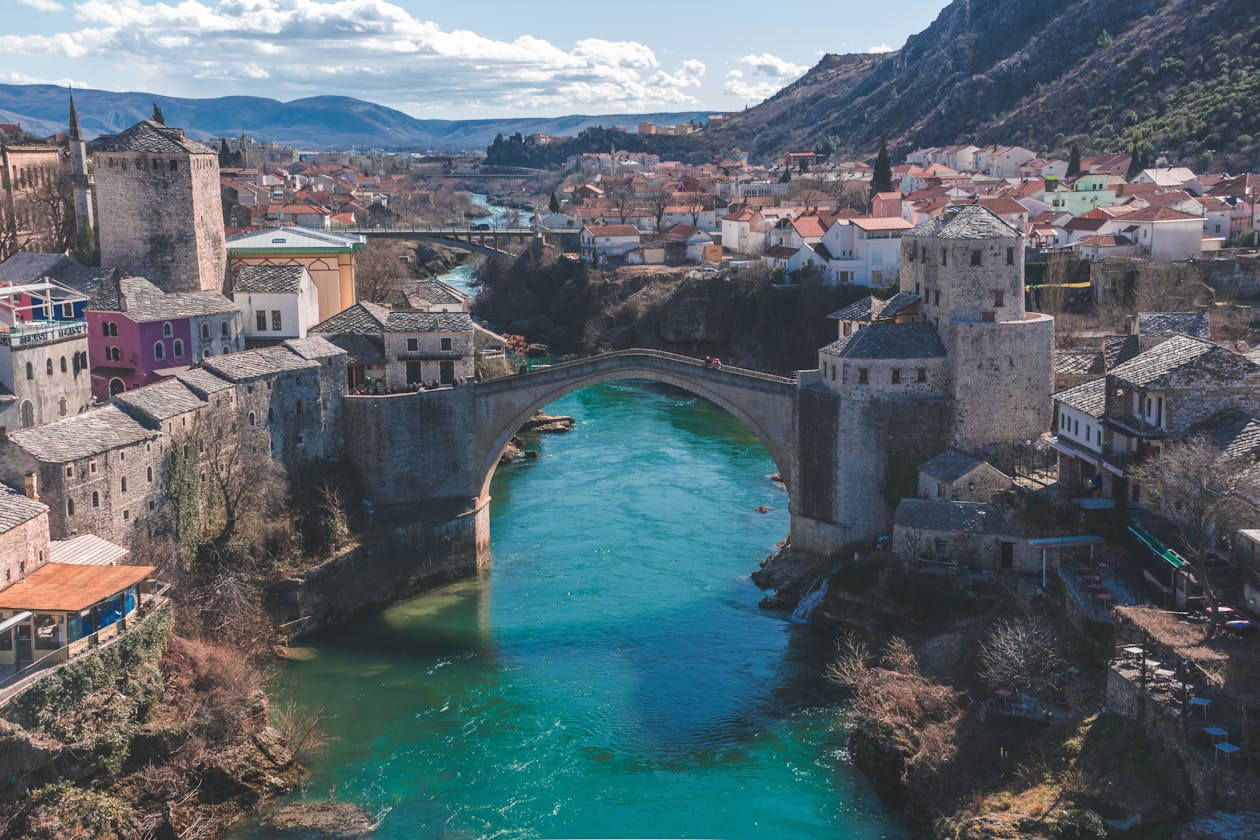
- Kotor to Mostar: 3-4 hours via Trebinje. The Stari Most bridge and Ottoman quarter are the draw
- Kotor to Shkodër: roughly 3 hours through Podgorica and along Lake Skadar. A different country, a different pace entirely
- Kotor to Belgrade: 6-7 hours via Podgorica and the E65 north. Motorway most of the way on the Serbian side
- Kotor to Tirana: around 3.5 hours via Podgorica and Hani i Hotit, Albania's capital, its fast-growing nightlife and Enver Hoxha-era bunker museums wait on the other side
Looking for a car that comes with cross-border paperwork already arranged? Search our fleet, tick the countries you plan to visit at booking, and the Green Card will be in the glovebox when you collect the keys.